

By Sight Partners
Glaucoma management continues to evolve as new technologies and treatment strategies emerge to address one of the most persistent challenges in eye care: preventing vision loss despite good medical therapy.
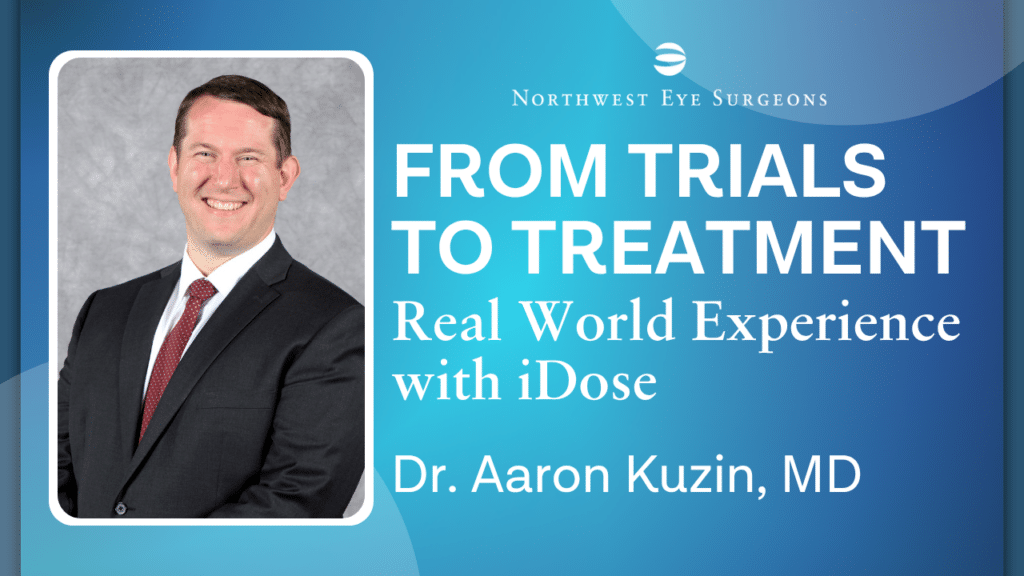
In a recent Sight Partners webinar, Dr. Aaron Kuzin, MD shared his real-world experience and early outcomes with the iDose® TR sustained-release implant, placing it within the broader context of modern glaucoma management.
Understanding the Challenge: Why New Approaches Are Needed
Despite decades of progress, glaucoma remains a leading cause of irreversible blindness. As Dr. Kuzin reminded viewers, long-term studies still show that 20–30 percent of patients lose significant vision in at least one eye over time, even with treatment.
Medication non-adherence plays a major role. Between 40 and 80 percent of glaucoma patients struggle to use drops correctly or consistently, whether from cost, side effects, or the complexity of multi-drop regimens.
Repeated dosing also contributes to ocular-surface inflammation and dry eye, further reducing quality of life and adherence.
“We sometimes underestimate how hard it is for patients to manage this disease day after day,” Dr. Kuzin explained. “Anything we can do to simplify treatment and provide steadier control can make a real difference.”
Shifting the Paradigm: Toward Interventional Glaucoma
Traditionally, U.S. glaucoma care followed a familiar sequence: medications → laser → surgery.
Dr. Kuzin believes that model is changing.
“We’re moving toward a more proactive, interventional mindset,” he said. “That means intervening earlier to stabilize pressure and reduce dependence on drops, rather than waiting until patients are failing medical therapy.”
This shift includes selective laser trabeculoplasty (SLT) as a first-line therapy, minimally invasive glaucoma surgeries (MIGS), and now long-acting drug-delivery implants such as iDose TR.
Introducing iDose TR
Approved in late 2023, iDose TR is a tiny implant that continuously releases medication inside the eye for one to three years.
It can be performed as a standalone procedure or combined with cataract surgery or MIGS.
When its effect tapers, the implant can be removed and replaced during a brief procedure.
Clinical-trial data have been encouraging:
- At 12 months, 93 percent of patients were controlled on the same or fewer medications.
- 81 percent required no topical IOP-lowering drugs at one year.
The implant has been approved for a broad range of glaucoma severity, from ocular hypertension to refractory disease.
Dr. Kuzin’s Early Experience
Dr. Kuzin has now completed more than 70 iDose procedures, both standalone and in combination with other surgeries.
Standalone iDose (n = 42)
- Average IOP reduction: −2.33 mm Hg
- Medication change: −1 drop (many patients were already at target)
- 62% drop-free at follow-up
- Largest IOP drop: 12 mm Hg; minimal adverse events reported
Combined iDose + MIGS or Cataract (n = 24)
- Average IOP reduction: −5.39 mm Hg
- 9 patients completely off drops
- Every patient saw at least some pressure reduction
- Occasional mild inflammation or transient hyphema, clearing within one to two weeks
Overall, Dr. Kuzin describes the procedure as “quick, straightforward, and well-tolerated,” typically taking about three minutes through a 1.8 mm incision under light sedation.
Selecting the Right Patient
Dr. Kuzin emphasized that iDose TR isn’t for everyone, but it fills an important gap.
Ideal candidates include:
- Patients who are non-adherent or intolerant to topical drops
- Those with ocular-surface disease or allergy to medications
- Individuals needing steadier, around-the-clock IOP control
- Glaucoma patients undergoing cataract surgery who want to reduce their medication burden
He also continues to use SLT as a first-line treatment in newly diagnosed patients, reserving iDose TR for those already on drops or those motivated to reduce their drop load.
Co-Management and Practice Integration
Because iDose TR is visible at the slit lamp, optometrists can easily monitor implant position and postoperative status.
Sight Partners has begun co-managing these patients, with follow-ups billed as standard glaucoma visits (the standalone implant carries no global period).
Dr. Kuzin also noted that Medicare with supplemental coverage currently provides the most predictable reimbursement, and patients are informed of cost estimates in advance.
Looking Ahead
Dr. Kuzin closed by emphasizing that the goal of interventional glaucoma is not to replace medications entirely, but to individualize care and improve long-term stability.
“If we can keep patients seeing well for their lifetime—with fewer daily barriers—that’s success,” he said.
Watch the Full Webinar
For a deeper look at Dr. Kuzin’s experience, case examples, and Q&A discussion with colleagues, watch the full on-demand webinar here:
(This educational webinar is not for CE credit.)

